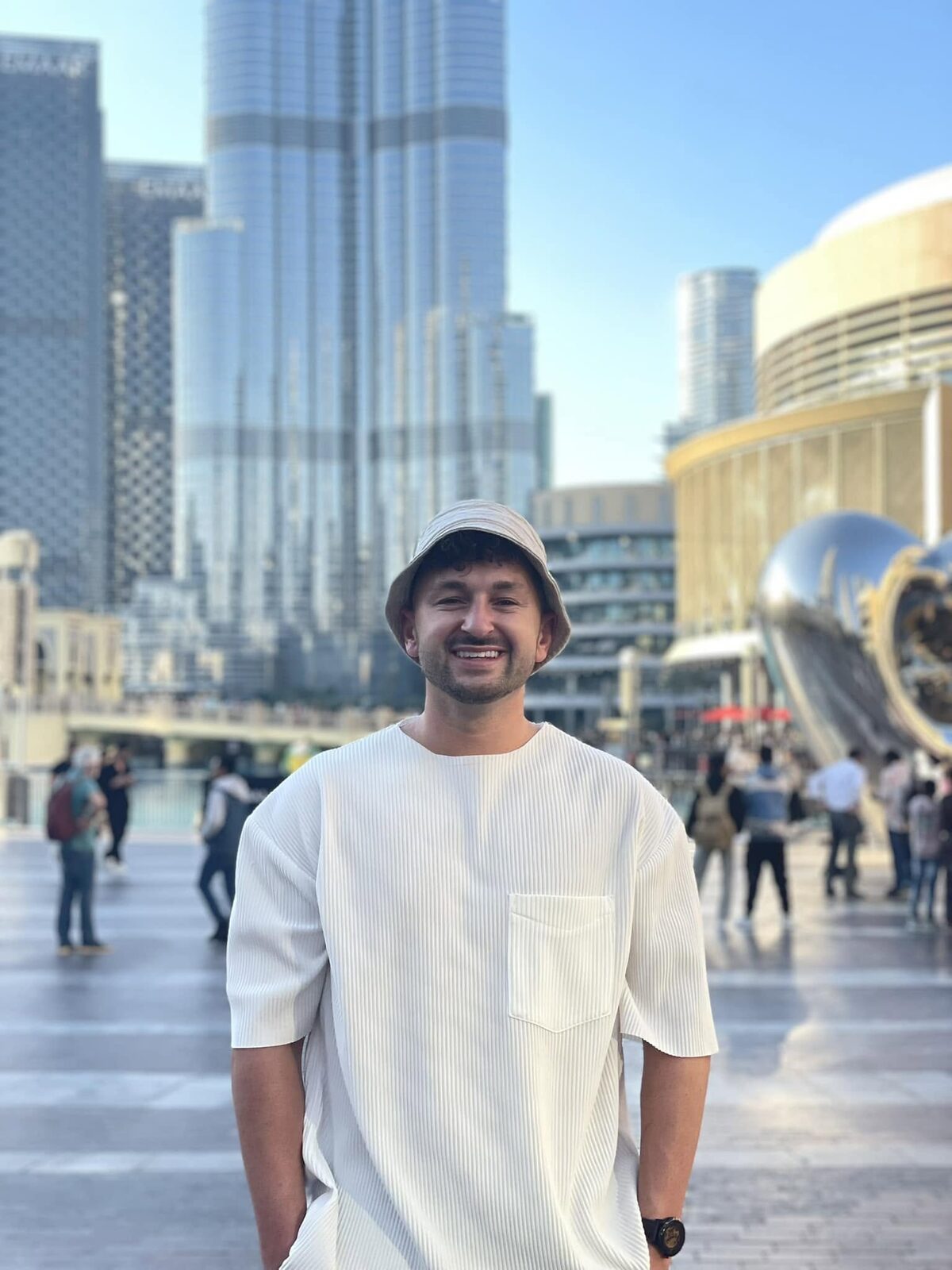
Most TikToks take a few minutes to film and a few minutes to edit. An MDMotivator video doesn't work that way.
Zachery Dereniowski has been remarkably open in interviews about the labor behind his content, and the numbers are surprising. A typical 30-second video can take roughly four hours to shoot and another two hours to edit. That math, by his own description, is the price of keeping things real — and "real" is the entire point.
Here's how the videos actually come together, based on what Zachery has shared publicly during the years his format took shape.
The Notepad
Before any sign goes up, before any blindfold goes on, every MDMotivator video starts somewhere private and unglamorous: a notepad.
In a 2021 interview with the Windsor Star, Zachery described his project as a 24/7 passion job, and explained that he keeps an ongoing notepad of ideas — concepts for signs, scenarios for social experiments, questions to ask strangers, hooks that might land. New ideas come from anywhere: a song lyric, a conversation overheard in a café, a thought that hits him on a walk. Some ideas sit in the notebook for weeks. Some get filmed the same week they're written.
This is one of the reasons the videos feel so varied even though the format is consistent. Behind every sign is an idea that survived the notepad — a question worth asking out loud in a public place.
The Unscripted Rule
The most important rule of MDMotivator's process is that the videos are not scripted. None of the strangers are actors. None of the conversations are pre-arranged. None of the reactions are pre-rehearsed.
In multiple interviews, Zachery has described why he refuses to script: people would feel it. The Windsor Star quoted him explaining that writing a script would be easier and faster, but the audience would sense the inauthenticity instantly. The realness, he's said repeatedly, is the entire substance of the videos. A 2022 Digital Phablet profile captured the same idea — that he's chasing real human connection through storytelling and vulnerability, and any shortcut to that ruins the whole point.
This is also why the process takes so long. Unscripted means you can't predict anything. Some people walk past. Some say no. Some say something so beautiful you couldn't have written it. Some throw Skittles at you, which actually happened — a young woman, blindfolded for one of the experiments, reacted by tossing Skittles at Zachery, a moment he's referenced in interviews as one of his most memorable on-set surprises. He didn't escalate. He let it pass. According to his own description, he tries never to match negative energy when it shows up.
The patience that requires is the work. Most of those four hours of shooting aren't filming. They're waiting.
The Camera, the Distance, and the Frame
The visual format of MDMotivator videos was largely established in the early years by Zachery and his longtime videographer Patrick Glaz, who's been profiled separately in our series. The shooting style has remained consistent enough that fans recognize an MDMotivator video within seconds.
A few choices that define the look:
The camera is held back, often ten to fifteen feet from the action. This keeps strangers comfortable and the footage candid rather than performed. Zachery and the subject typically appear together in the same frame — instead of cutting back and forth between two faces like a typical influencer interview, the videos let the connection sit visually in one shot. The lighting is whatever the world gives you that day: harsh sun, parking-lot fluorescents, rainy afternoon greys. None of it gets fought.
These are disciplined choices, not flashy ones. They're a big part of why the videos read as genuine even on a platform full of polished, performative content.
The Edit
After the four-hour shoot comes the two-hour edit. That's a deliberately slow ratio for short-form video — most TikTok creators edit a 30-second clip in 30 minutes — and it's where MDMotivator's emotional pacing actually gets built.
The edit decides which moments land. When to cut. When to linger on a face. When to let silence sit instead of stuffing the soundtrack. When to drop in a swell of music versus when to leave a moment dry. Watch a few videos in a row and you'll notice the editor's hand: the cuts come in on emotional beats, not visual ones, which is why the videos feel like miniature documentaries rather than highlight reels.
Two hours per 30 seconds also means a single posting day represents an enormous amount of accumulated time. A creator posting three or four videos a week, at MDMotivator's standard, is putting in real production hours behind every clip.
The Approach
The actual on-the-ground execution of an MDMotivator video usually takes one of a few familiar forms.
The Sign Setup. Zachery stands in a public place — a mall, a busy sidewalk, a park — holding a cardboard sign with a question or invitation. People can ignore him, or they can stop. Whoever stops becomes the video.
The Help Request. He approaches a stranger and asks for something small — a dollar, a soother for a baby, a phone charger, bus money. Whoever helps gets rewarded with something much larger than they could have expected. This is the format that has produced some of the biggest viral campaigns, including the Ronke video in March 2025 and the Denise video in April 2026.
The Public Setup. He sits, often blindfolded or appearing injured, in a public place — outside a grocery store, on a busy corner, in front of a pawn shop in the rain — and waits to see who stops. This format produced the Elvin birthday cake video in Austin and the Detroit pawn shop moment with Denise.
The Choice. A stranger is offered a choice between something obvious (cash) and something mysterious (a wrapped gift, a sealed envelope, a basketball). The choice itself reveals something about the person, which becomes the heart of the story. The most famous example is the Chantwan moment in Detroit in July 2025, when a 51-year-old veteran chose a mystery basketball over $1,000 in cash and ended up changing his life.
Each format gives Zachery a different angle on the same fundamental experiment: when given the chance, who chooses kindness? And what happens when kindness gets rewarded on a scale the person never expected?
What's Changed at Scale
Most of the production details described above come from interviews Zachery gave in 2021 and 2022, when MDMotivator was still primarily a two-person operation between Zachery and Patrick Glaz. The format hasn't changed. The pacing of the work hasn't visibly changed. But the operation around the videos clearly has.
Today, an MDMotivator shoot can involve coordinating with major brands like BetterHelp, KIND Snacks, or iMerchant, with celebrities like Ice Cube, Big Sean, Taraji P. Henson, Drake, or Beast Games season 2 winner Tyler Lucas, and with civic figures like Detroit Mayor Mary Sheffield. Slingshot fundraisers have to be set up and managed in parallel. Sponsor integrations get woven into video descriptions. The signs are still cardboard, but the logistics around them have grown significantly.
What's stayed constant — and what every interview Zachery has given consistently emphasizes — is the principle underneath. The videos are unscripted. The strangers are real. The reactions are unrehearsed. The emotion is unforced. Whatever scale the operation has reached, that's the rule it was built on.
Coming Up Next
Now that we know how the videos get made, the next question is what's actually written on those signs. Our next article decodes the most iconic MDMotivator signs of all time — what each one says, why it works, and the stories behind the cardboard.
Sources
- "Windsor-born TikToker earns an audience of millions" — Dan Janisse, Windsor Star, via The Canadian News (October 27, 2021), source for the four-hour shoot / two-hour edit ratio and the notepad of ideas: https://thecanadian.news/windsor-born-tiktoker-earns-an-audience-of-millions/
- "5 Important Messages From MDMotivator Who Went Viral For Giving Hugs" — Digital Phablet (July 22, 2022), source for the unscripted philosophy, the Skittles incident, and the "never match negative energy" principle: https://www.digitalphablet.com/healthcare-tech/important-messages-mdmotivator/
- "Meet Patrick Glaz | Photographer and Videographer" — Shoutout SoCal (June 7, 2022): https://shoutoutsocal.com/meet-patrick-glaz-photographer-and-videographer/
- "Zachery Dereniowski's Chantwan post goes viral" — PRIMETIMER (July 24, 2025), covering the Detroit mystery basketball moment: https://www.primetimer.com/news/zachery-dereniowski-chantwan-post-fundraiser-army-veteran-prison
- mdmotivator.com homepage, listing recent video formats and sponsor / celebrity collaborations: https://mdmotivator.com/
Note: The detailed production process described in this article is sourced primarily to interviews from 2021–2022. The MDMotivator operation has scaled significantly since then, but the unscripted format and basic shooting approach remain visibly consistent in current videos.
This article is part of an independent fan site dedicated to documenting the work, life, and impact of Zachery Dereniowski (MDMotivator). We are not affiliated with Zachery, his team, Kindness Is Cool, the Mental Health Movement, the KindnessWithZachery Foundation, or any of his sponsors. All content is researched and written by fans, sourced from public material, and intended as celebratory and informational. To follow Zachery directly, visit @mdmotivator on TikTok or Instagram.